
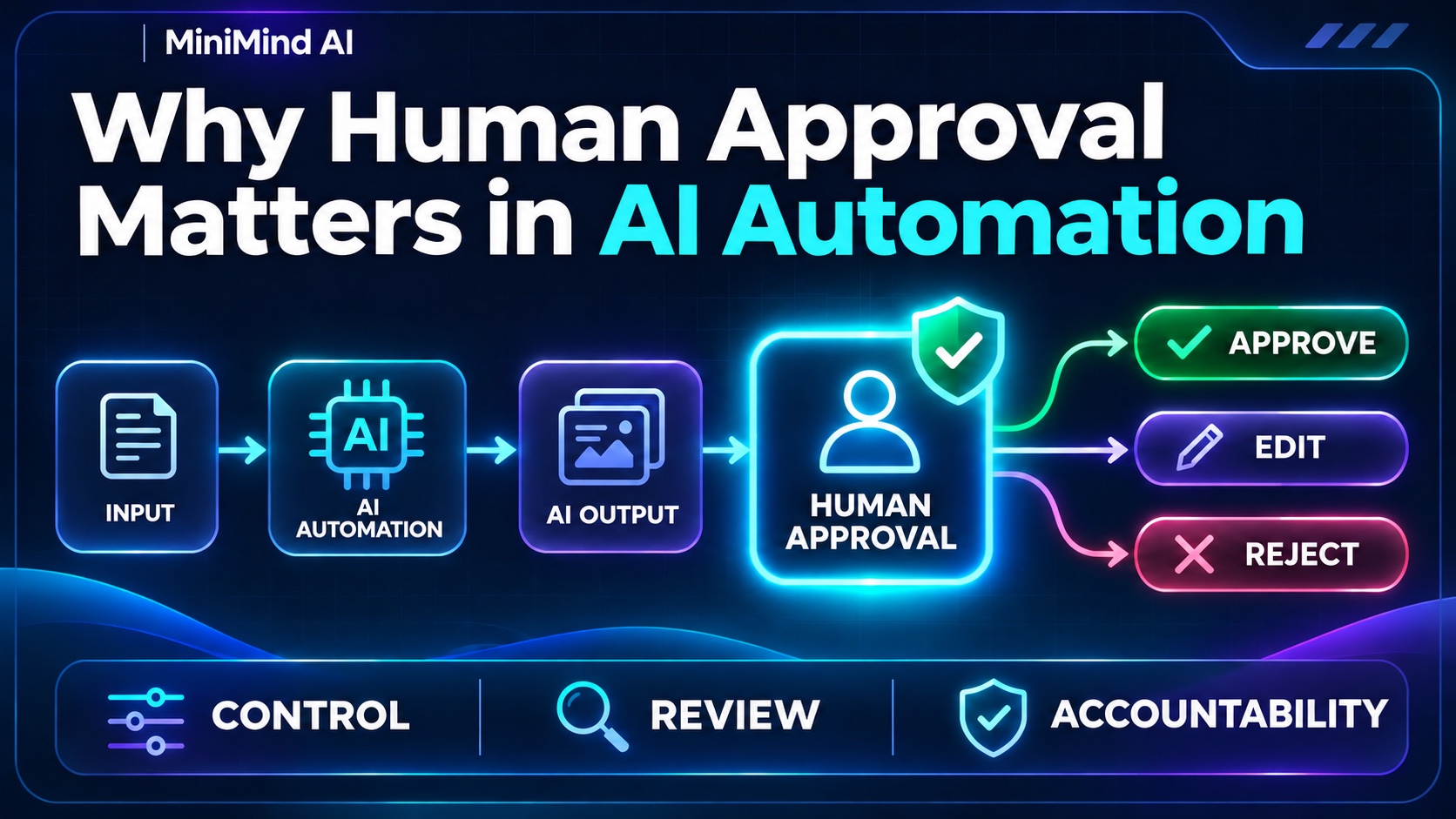
Why Human Approval Matters in AI Automation
Learn how to design meaningful human checkpoints that improve AI quality, safety, and accountability without slowing every task down.
Why Human Approval Matters in AI Automation
Human approval is sometimes described as a failure of automation. In real businesses, it is often what makes automation usable. The goal is not to review every token; it is to place judgment where context, accountability, or consequences require it.
What AI can do before approval
AI can gather and normalize information, generate options, summarize evidence, draft content, classify requests, and prepare recommendations. Humans should approve decisions affecting commitments, money, access, reputation, safety, legal exposure, or customer experience.
Make the checkpoint meaningful
A weak checkpoint says “click approve” without showing what is being approved. A strong checkpoint presents the recommendation, evidence, uncertainty, alternatives, and consequences. It lets the reviewer edit, reject, ask for revision, or send the work back to a specific step.
MiniMind’s Guided Agentic Workflows describes review as selecting options, answering questions, approving assets, adjusting tone, and deciding which branches continue.
Three kinds of review
Quality review: Is the output accurate and complete?
Decision review: Is this the right recommendation in context?
Action review: Should the system send, publish, purchase, change, or delete something?
A blog outline may need quality review. A refund workflow may need decision and action review.
Example: outreach automation
AI can research a public company page and propose an outreach angle. It should not decide that a prospect has budget or urgency. A sales lead can approve the angle, correct a source, choose the channel, and remove unsupported claims before the sequence is generated.
MiniMind’s Lead Research & Outreach Sequence demonstrates this pattern with an approval step between research and copy generation.
Reduce review fatigue
Group related decisions, highlight changes and uncertainty, apply deterministic checks first, route exceptions to review, let reviewers define reusable preferences, and record why a decision changed. The best checkpoint is short because preparation was automated, not because the person was removed.
Design for disagreement. Offer reasons such as missing context, bad source, wrong audience, or unacceptable risk. Ask for a correction target instead of making the reviewer rewrite everything.
Keep an audit trail
For important workflows, record the input version, recommendation, sources, reviewer decision, edits, and final action. This supports debugging and accountability and shows whether the system is improving.
Do not automate a high-consequence decision if you cannot define review authority, required evidence, rollback, and outcome owner. Keep the system assistive until those controls exist.
MiniMind’s documentation frames AI as a structured, editable workbench and advises reviewing and validating generated outputs.
FAQs
Does approval make automation slow?
It can if placed everywhere. Put it at decision boundaries and automate the preparation around them.
Can approval be delegated?
Yes, if the delegate has authority, context, and an escalation path.
What if a reviewer always approves?
Measure whether review adds value. Automate low-risk cases while keeping exceptions and periodic audits.
What should the reviewer see?
The proposed result, relevant evidence, uncertainty, changes, and available actions.
Final takeaway
Human approval is not an obstacle to useful automation. It keeps judgment, accountability, and learning inside the system while AI handles repetitive work.