
Why We Built CSP v1: Rethinking Prompt Engineering for AI Agents
AI prompts are becoming more complex, making them hard to maintain and costly to execute. Learn why MiniMind AI created CSP v1, a structured prompt DSL that treats prompts as software configurations.
Why We Built CSP v1: Rethinking Prompt Engineering for AI Agents
The Problem We Kept Seeing
While building MiniMind AI, we noticed something interesting.
As AI workflows become more capable, prompts become larger.
A simple chatbot might use:
- One system prompt
An agent workflow might use:
- Planner prompt
- Research prompt
- Reviewer prompt
- Writer prompt
- Evaluator prompt
Each prompt contains:
- Role definitions
- Instructions
- Constraints
- Guardrails
- Output schemas
- Tool rules
- Examples
Over time, prompts become difficult to:
- Maintain
- Review
- Version
- Optimize
- Reuse
More importantly, they become expensive.
A multi-agent workflow can easily spend thousands of prompt tokens before generating a single useful response.
This led us to a simple question:
Are we treating prompts as documents when we should be treating them as configurations?
The Evolution of Software
Software engineering already solved a similar problem.
We don't write machine code directly.
Instead, we write:
- Python
- JavaScript
- Java
- C#
Then compilers and interpreters transform those instructions into machine-readable representations.
Prompt engineering today often looks like software development before compilers became mainstream.
Large English paragraphs attempt to encode:
- Roles
- Constraints
- Permissions
- Output contracts
- Execution behavior
all inside prose.
That works.
But it doesn't scale well.
The CSP v1 Idea
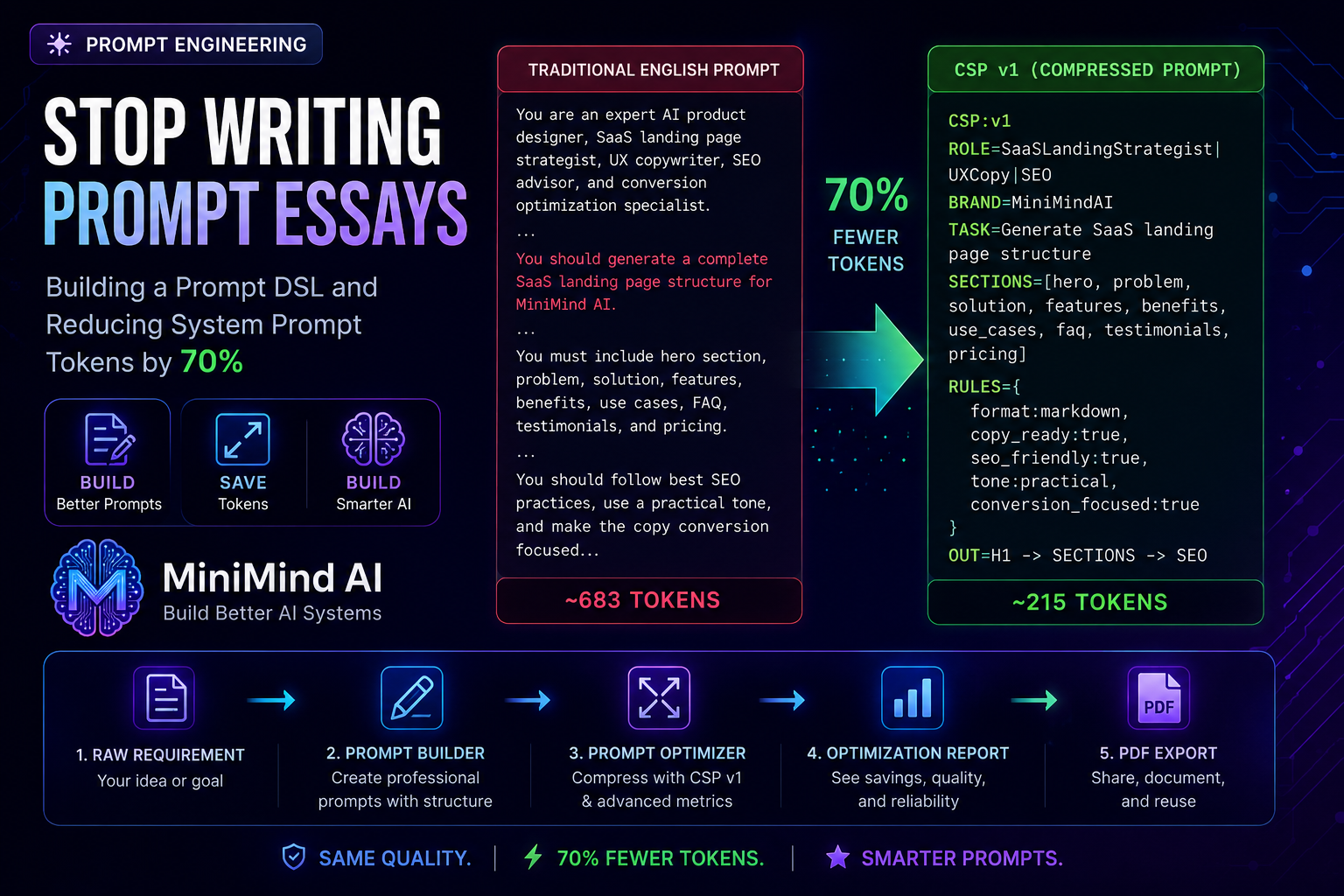
CSP stands for:
Compressed System Prompt
The goal of CSP v1 is not merely compression.
The goal is structured prompt representation.
Instead of:
You are a competitor research expert.
Always cite sources.
Do not hallucinate.
Generate markdown output.
Require approval before finalizing results.
CSP v1 represents the same intent as:
CSP:v1

ROLE=CompetitorResearch

RULES=[
 cite_sources,
 markdown_output
]

FORBID=[
 hallucinations
]

APPROVAL=true
This creates a prompt structure that is:
- Easier to generate
- Easier to analyze
- Easier to optimize
- Easier to version
- Easier to reuse
Why Compression Was Only Part of the Story
Our original goal was prompt optimization.
However, during testing we discovered something unexpected.
When prompts become structured:
- Compression naturally follows.
- Analysis becomes easier.
- Prompt generation becomes easier.
- Workflow integration becomes easier.
The real insight wasn't:
"We reduced tokens."
The real insight was:
"We transformed prompts into data."
CSP v1 as a Prompt Architecture Layer
We do not currently view CSP v1 as a replacement for English.
Instead, we see it as an intermediate representation.
Similar to how:
Source Code
    ↓
Compiler
    ↓
Machine Instructions
We envision:
Raw Requirement
    ↓
Prompt Builder
    ↓
CSP v1
    ↓
Prompt Optimizer
    ↓
Final Prompt
The structured representation becomes the foundation for future tooling.
Why We Built Prompt Builder
Most users don't want to write system prompts.
They want outcomes.
Our new AI Prompt Builder converts:
Raw Ideainto
Professional Promptwhile automatically generating:
- Roles
- Constraints
- Output contracts
- Safety instructions
Why We Built Prompt Optimizer
Our AI Prompt Optimizer converts:
Professional Promptinto
Optimized Promptwhile generating:
- Compression reports
- Preservation analysis
- Token savings metrics
- CSP v1 representations
Why We Built Prompt Architect Suite
Eventually we realized users needed a complete workflow.
AI Prompt Architect Suite combines:
Prompt Builder
        ↓
Prompt Analysis
        ↓
Prompt Optimization
        ↓
Compression Report
        ↓
Export Package
into a repeatable, guided process.
Future Research Directions
CSP v1 is an experiment.
Not a standard.
Not a benchmark.
Not a claim that structured prompts are always better.
However, we believe several areas deserve further exploration:
Prompt Versioning
Treat prompts like source code.
Prompt Diffing
Compare prompt revisions.
Prompt Quality Analysis
Detect missing guardrails and contradictions.
Agent Configuration DSLs
Represent agent capabilities as structured definitions.
Workflow-to-Prompt Compilation
Generate prompts directly from workflow configurations.
Final Thoughts
Prompt engineering is still young.
Today, most prompts are written manually as English documents.
Tomorrow, prompts may become:
- Generated
- Structured
- Versioned
- Optimized
- Compiled
CSP v1 is our attempt to explore what that future might look like.
Whether CSP v1 survives or evolves into something else, one thing has become clear:
Prompts are increasingly behaving less like documents and more like software artifacts.
And software artifacts benefit from structure.