
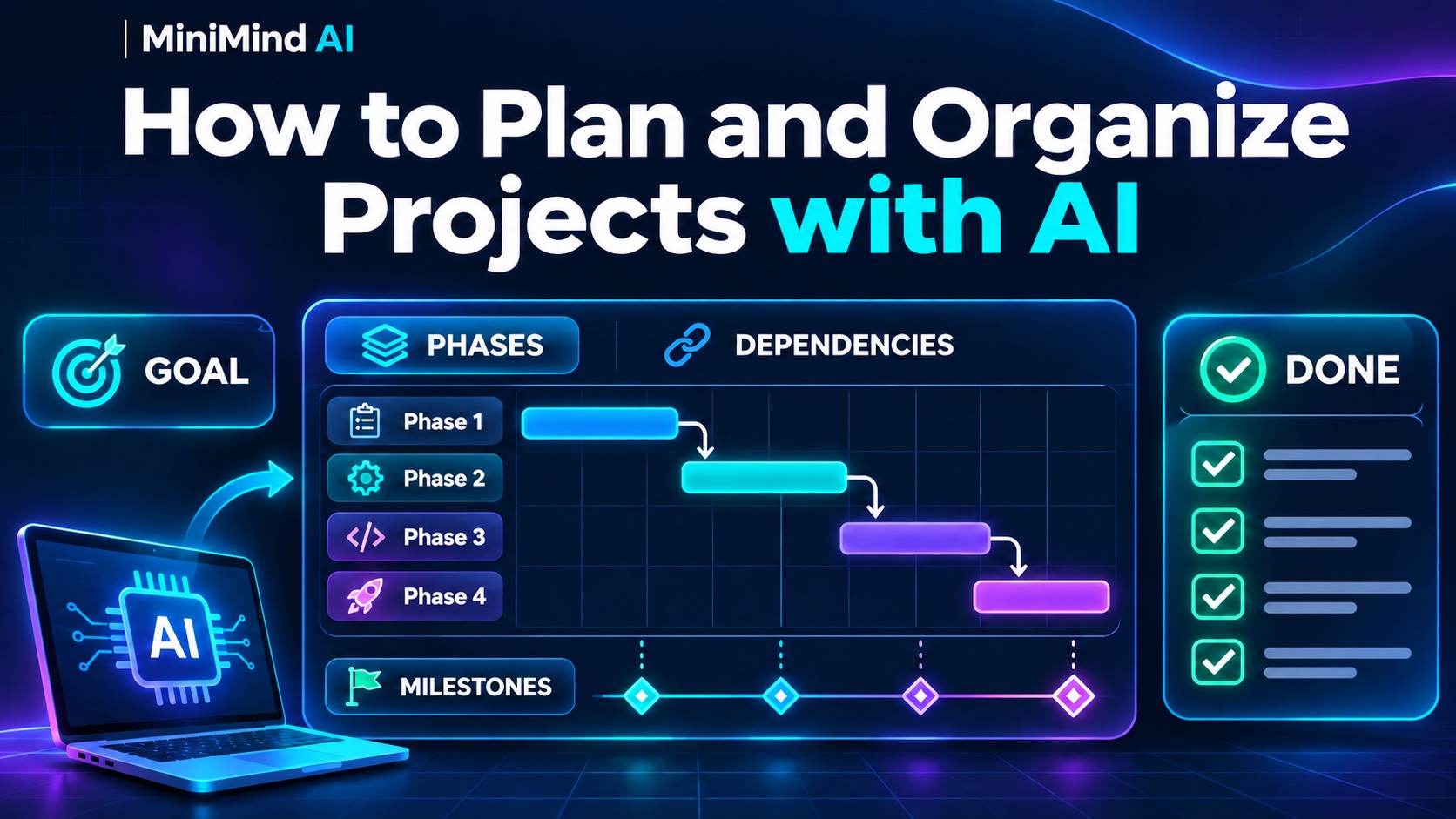
How to Plan and Organize Projects with AI
Create a useful AI project plan with phases, dependencies, effort estimates, review points, and a definition of done.
How to Plan and Organize Projects with AI
An AI task list can look productive while hiding what matters: the outcome, sequence, dependencies, and proof of completion. Use AI to make a first plan, then improve it with constraints and human ownership.
Start with the outcome
“Launch a website” is vague. “Publish a five-page site with approved copy, analytics, contact form, accessibility checks, and a rollback plan by 15 September” is actionable.
Add team size, budget, dependencies, technology, approvals, risks, and a definition of done for each deliverable.
Ask for phases
A useful plan may include clarify and scope, research and decisions, build or produce, review and test, launch or hand off, and measure and improve.
MiniMind’s AI Task Planner generates phased boards with priorities, effort labels, checklists, and Markdown or JSON export. Its Product Launch Task Planner adds pre-launch, launch-day, and post-launch structure.
Example: a 90-day SaaS launch
Phase 1: interview users, define the problem, choose the narrow promise, and write acceptance criteria.
Phase 2: build the core flow, onboarding, measurement, and support path.
Phase 3: run a small pilot, observe usage, fix blockers, and document objections.
Phase 4: launch with landing page, demo, pricing, and support materials.
Phase 5: review activation, retention, support load, and conversion before adding features.
The plan is useful because it sequences learning before scale.
Add dependencies and decision gates
Identify tasks that cannot start until another is complete, decisions that unlock multiple downstream tasks, external owners, and review points where the plan may change. Copy approval can block a page; a security decision can affect architecture and timeline.
AI effort estimates are hypotheses. Replace them with team knowledge after the first cycle and record why they changed.
Every task needs an owner, verb, input, and completion test. “Prepare launch assets” is too broad. “Draft the product page from approved positioning and submit it for founder review” is actionable.
FAQs
Can AI manage my project automatically?
It can maintain plans and summarize status, but owners must make trade-offs and confirm completion.
How many phases?
Usually four to six for a first plan. More phases do not automatically mean more control.
Should I export?
Yes. Keep a durable copy when the plan becomes a handoff or record of decisions.
Final takeaway
AI planning is valuable when it turns an outcome into an executable sequence with visible dependencies and review points. Let the model propose structure; let the team own reality.