Reasoning Models: Understanding Chain-of-Thought
How 'System 2' thinking and inference-time compute are enabling AI to solve logic and science problems.
Reasoning Models: Understanding Chain-of-Thought
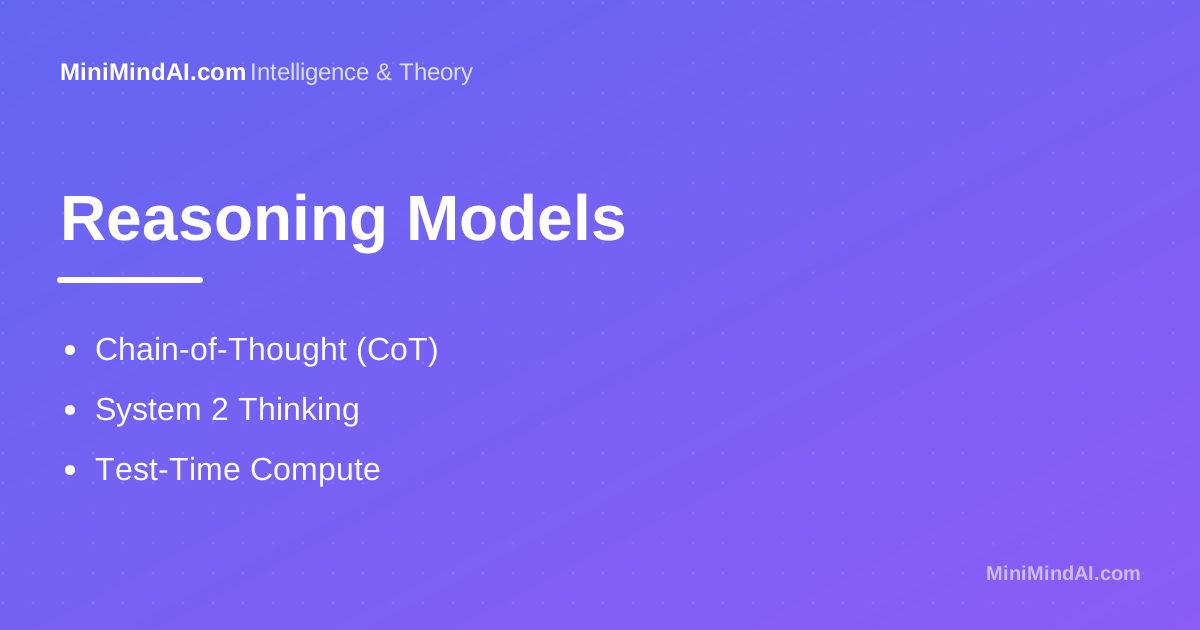
Most AI models are "System 1" thinkers—they respond instantly without "thinking through" the steps. Reasoning Models (like OpenAI's o1 or models using Chain-of-Thought) shift AI into "System 2"—slower, more deliberate, and much more accurate.
What is Chain-of-Thought (CoT)?
CoT is a technique where the model is encouraged to "show its work." Instead of jumping straight to an answer, it breaks the problem into logical steps.
Example:
- Query: "I have 3 apples. I give 1 away and buy 2 more. How many?"
- Standard response: "4."
- CoT response: "1. Start with 3. 2. 3 - 1 = 2. 3. 2 + 2 = 4. Final: 4."
The Breakthrough: Inference-Time Compute
Recent research shows that if you give a model more "time to think" (more compute during the response), its performance on complex math and coding tasks skyrockets.
Self-Correction: The Holy Grail
The most advanced reasoning models can "look at their own thoughts" and say, "Wait, that step doesn't make sense," and then try a different path. This Self-Correction is what allows AI to solve high-level competitive math and PhD-level science problems.
Conclusion
Reasoning models are the key to unlocking "Expert" level AI. As we improve these systems, AI will move from being a "writing assistant" to a "scientific researcher" that can discover new drugs and solve unsolvable equations.
Finally, we look at the economy of intelligence: The Cost of AI.
Do you find yourself prompting AI to "think step by step"? Now you know why it works!