AI vs Traditional Software Tools: When Should You Use Each?
A decision framework for choosing AI, deterministic software, or a hybrid system based on variability, verification, and cost of error.
AI vs Traditional Software Tools: When Should You Use Each?
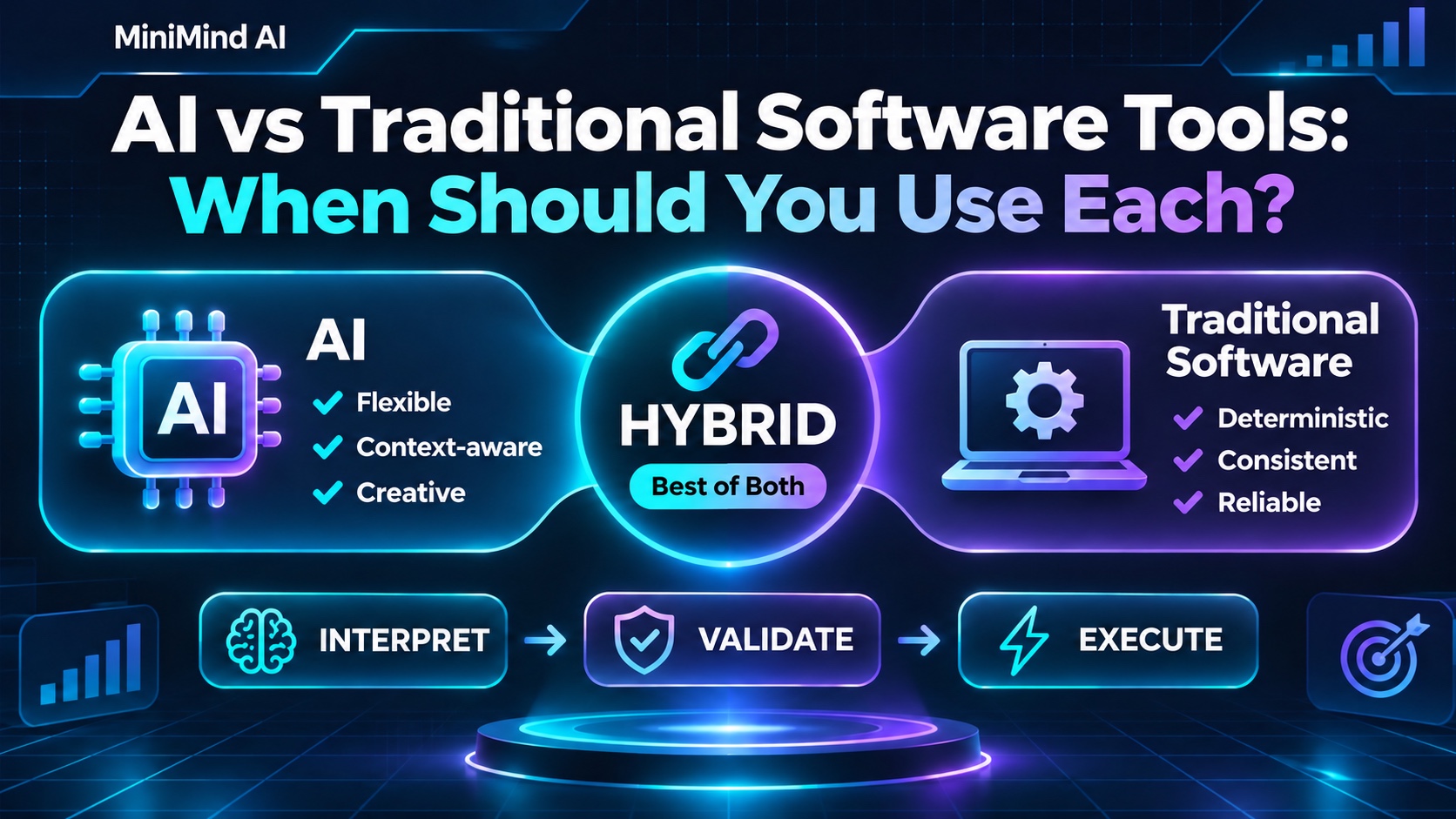
The question is not whether AI replaces traditional software. Ask which parts of a job need interpretation and which need exactness. AI is good at ambiguity, language, images, and patterns. Traditional software is good at rules, calculations, permissions, and repeatable state changes.
A simple decision test
- Are the inputs messy or structured?
- Is there one correct answer or several acceptable answers?
- Can a person review the result before harm occurs?
- What happens when the system is wrong?
If inputs are structured, the answer is exact, and errors are costly, start with deterministic software. If inputs are unstructured and the task is interpretive, AI may help. If the task mixes both, use a hybrid.
Three examples
Invoice totals should be calculated by software. AI may extract fields from an image, but rules should validate them.
AI can classify a customer email and draft a reply. A policy engine should decide refund eligibility, and a person may approve the message.
AI can turn requirements into candidate architecture documents. Engineers must validate security, capacity, and operational assumptions.
MiniMind positions itself as a set of specialized tools that generate structured, editable artifacts rather than an open-ended chat interface. See the MiniMind documentation.
The hybrid pattern
- Deterministic validation checks input.
- AI interprets or drafts.
- Rules check required fields and prohibited values.
- A human approves material decisions.
- Software records and executes a reversible action.
This keeps AI where it adds leverage and exact operations inside systems designed for exactness.
Cost of error changes the answer
A rough blog outline is low risk. A medical, legal, financial, identity, or production-infrastructure decision is not. Create an error budget: how often may the system be wrong, how will you detect it, and what is recovery?
Before adopting an AI tool, ask what it changes, whether you can inspect intermediate outputs, whether exports are durable, how data is retained, where approval occurs, and how model changes affect results. Review the current disclosures on the MiniMind homepage.
FAQs
Should AI replace a project manager?
No. Use it to draft phases and tasks; let the owner set priorities and commitments.
Is deterministic software always better?
No. It can be brittle when inputs are ambiguous. Match the tool to the problem.
What is the safest starting point?
Use AI for drafts and recommendations, keep execution reversible, and measure before expanding permissions.
Final takeaway
Use AI for interpretation and options. Use traditional software for truth, rules, permissions, and durable state. Combine them when the real job requires both.