Advanced RAG: Hybrid Search, Re-ranking, and the Path to Zero Hallucination
Basic RAG is no longer enough. Explore the multi-stage pipeline of Hybrid Search and Cross-Encoder Re-ranking for high-precision knowledge retrieval.
Advanced RAG: Hybrid Search, Re-ranking, and the Path to Zero Hallucination
Retrieval-Augmented Generation (RAG) has become the industry standard for grounding AI in private data. However, in 2026, "Basic RAG" (find top 5 chunks, send to LLM) is no longer sufficient. Users expect high precision, contextual relevance, and the ability to handle complex, cross-document queries.
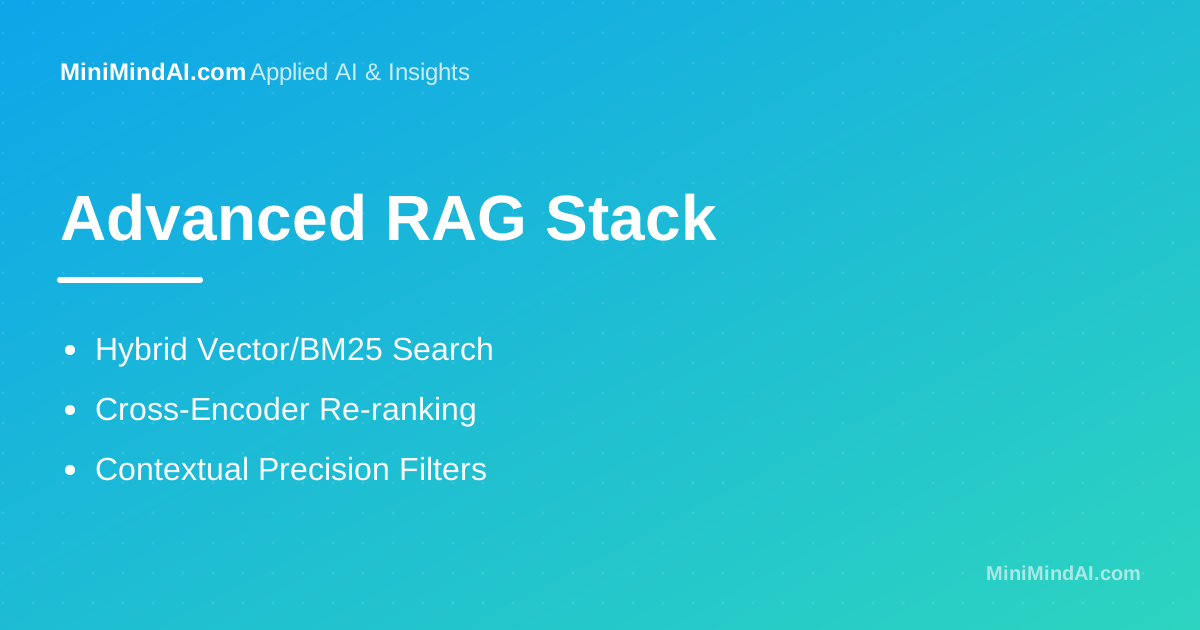
This guide explores the Advanced RAG Stack: moving beyond simple vector search to a sophisticated pipeline of Hybrid Search and Cross-Encoder Re-ranking.
The Advanced RAG Pipeline
Modern RAG isn't just a retrieval; it's a multi-stage refinement process.
1. Hybrid Search: The Best of Both Worlds
Vector search is great for meaning, but terrible for specific keywords or part numbers.
- Vector (Dense) Search: Finds "similar concepts." If you search for "laptop," it might return "notebook."
- Keyword (Sparse) Search: Uses BM25 to find exact matches. If you search for "SKU-9942," vector search might struggle, but keyword search will find it instantly.
- Fusion: In 2026, we use Reciprocal Rank Fusion (RRF) to combine these results into a single, optimized list.
2. Query Expansion and Multi-Query Transformation
Users are often bad at writing prompts.
- The Agentic Fix: Before searching, an agent takes the user's query and generates 3-5 variants (e.g., "how to fix a leak" -> "faucet repair guide," "plumbing troubleshooting," "water leakage solutions").
- The Result: By searching for all variants, the system ensures it catches the right information even if the user's terminology is slightly off.
3. The Power of Re-ranking (Cross-Encoders)
Vector search is "fast but fuzzy." Cross-Encoders are "slow but hyper-accurate."
- The Strategy: Use fast vector search to find the top 100 potential documents. Then, pass those 100 documents through a Re-ranker model.
- How it works: The Re-ranker looks at the exact user query and the exact document chunk together to calculate a relevance score. It then re-orders the list so the most perfect answer is at the very top.
4. Long-Context Management and Small-to-Big Retrieval
Sending huge blocks of text to an LLM wastes tokens and causes "lost in the middle" syndrome.
- Parent-Child Chunking: Store small chunks (100 tokens) for searching, but when a match is found, retrieve the larger "parent" context (500 tokens) to give the LLM enough information to understand the nuances.
- Context Filtering: Use an agent to strip away irrelevant boilerplate from the retrieved documents before sending them to the final completion model.
5. Metadata Filtering: The Precision Lever
In 2026, semantic search is always combined with hard filters.
- Example: "What was our revenue in Q3 for the European division?"
- The Execution: The system uses vector search for "revenue" and "Q3" but applies a hard database filter for
region == 'EU'. This prevents the AI from accidentally citing US or Asian data.
Performance Tip: Implementing a Semantic Cache (as discussed in our Cost Optimization guide) can reduce RAG latency by up to 80% for common repeat questions.
Building this level of precision requires a solid foundation in RAG Theory, moving beyond simple keyword matching to a deeper understanding of how AI retrieves and grounds itself in real-world facts.
Conclusion
RAG is the bridge between frozen model weights and a fluctuating world. By moving to an advanced, multi-stage pipeline, you transform your AI from a "guessing machine" into a "knowledge engine" that is verifiable, scalable, and trustworthy.
MiniMind AI provides the foundational engine and versatile tool suite needed to orchestrate your intelligent workflows and build your AI-driven future.